Domain-Specific Languages (DSLs) for Software Compliance Testing
What is a domain-specific language (DSL)?
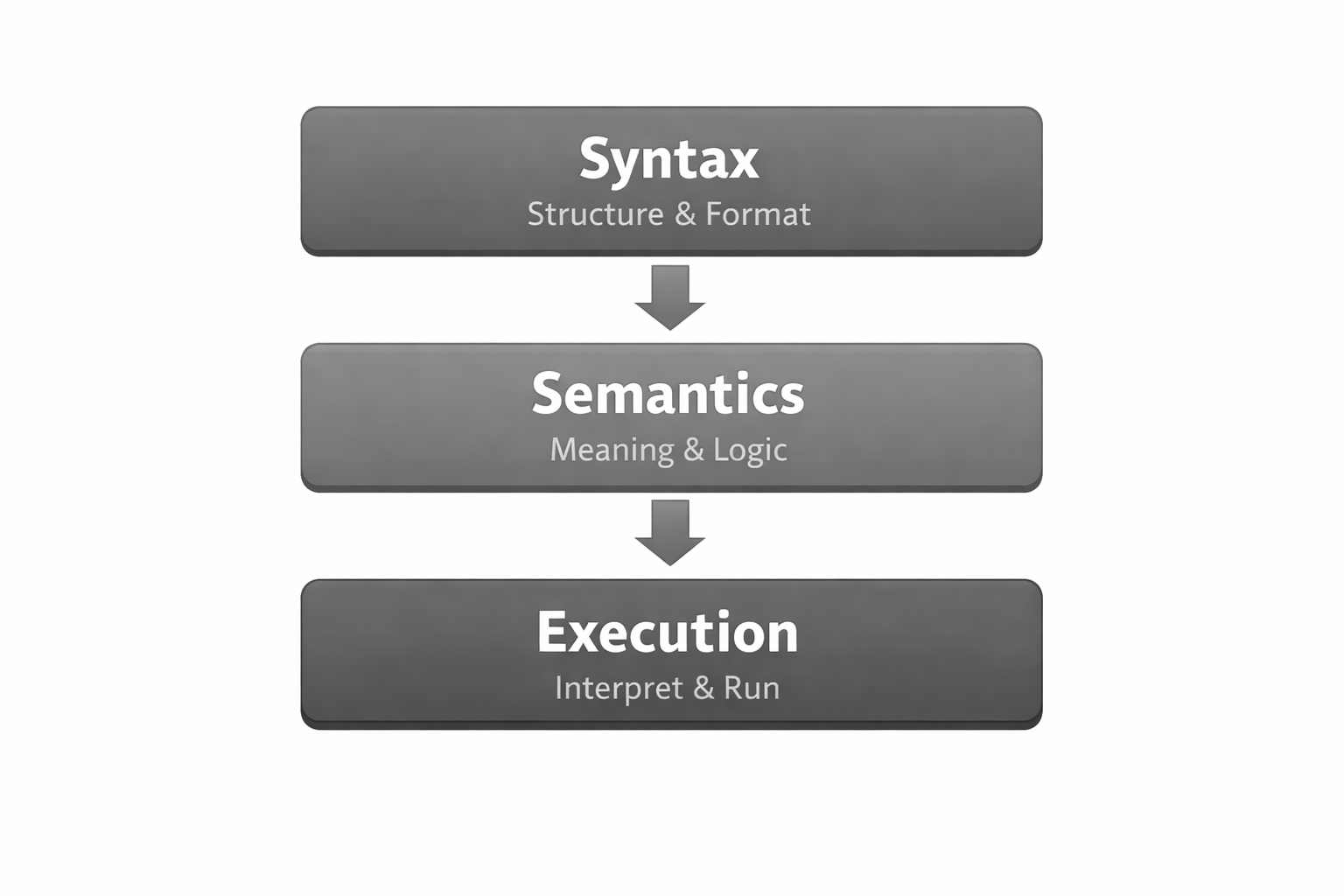
A Domain-Specific Language (DSL) is a specialized programming language designed to solve problems in a particular domain rather than serving as a general-purpose solution. Unlike general-purpose languages like Python or JavaScript, DSLs are tailored to express concepts and operations that are natural and idiomatic for a specific domain. Just like a traditional programming language, a DSL consists of syntax (the structure of the language) and semantics (the meaning of the constructs). What makes a DSL truly useful is a robust implementation – a parser, compiler, or interpreter that executes its constructs.
What does this have to do with software compliance testing?
Software compliance testing is, at its core, a policy abstraction problem.
Across nearly all compliance scenarios in software, the same fundamental structure appears:
- A set of requirements (standards, controls, policies, RFCs, internal rules)
- A set of software artifacts that reflect observed or declared behavior (certificates, configurations, source code, SBOMs, runtime state)
- A decision: compliant or not — and, critically, why
The primary challenge is not evaluating values or running checks. It is making policy explicit. Traditionally, compliance requirements are embedded implicitly inside software through:
- if statements
- ad-hoc validation logic
- hard-coded assumptions
- duplicated rules scattered across tools and services
This approach tightly couples policy to implementation. As a result, requirements become difficult to change, hard to audit, and nearly impossible to explain without inspecting the code that enforces them.
The key step is to treat policy as data – as an explicit, declarative description of what “acceptable” means, independent of how that acceptability is enforced.
Once policy is made explicit, a domain-specific language becomes the natural execution model. The DSL does not invent policy; it operationalizes it, allowing machines to interpret, evaluate, and report on compliance in a deterministic and explainable way.
This model applies to any software compliance problem where:
- system behavior can be observed or derived as artifacts, and
- requirements can be expressed as deterministic rules over those artifacts.
In practice, this means that any deterministic aspect of software behavior fits this model cleanly.
Software compliance testing model
In this framing, compliance testing is understood as program execution rather than ad-hoc validation.
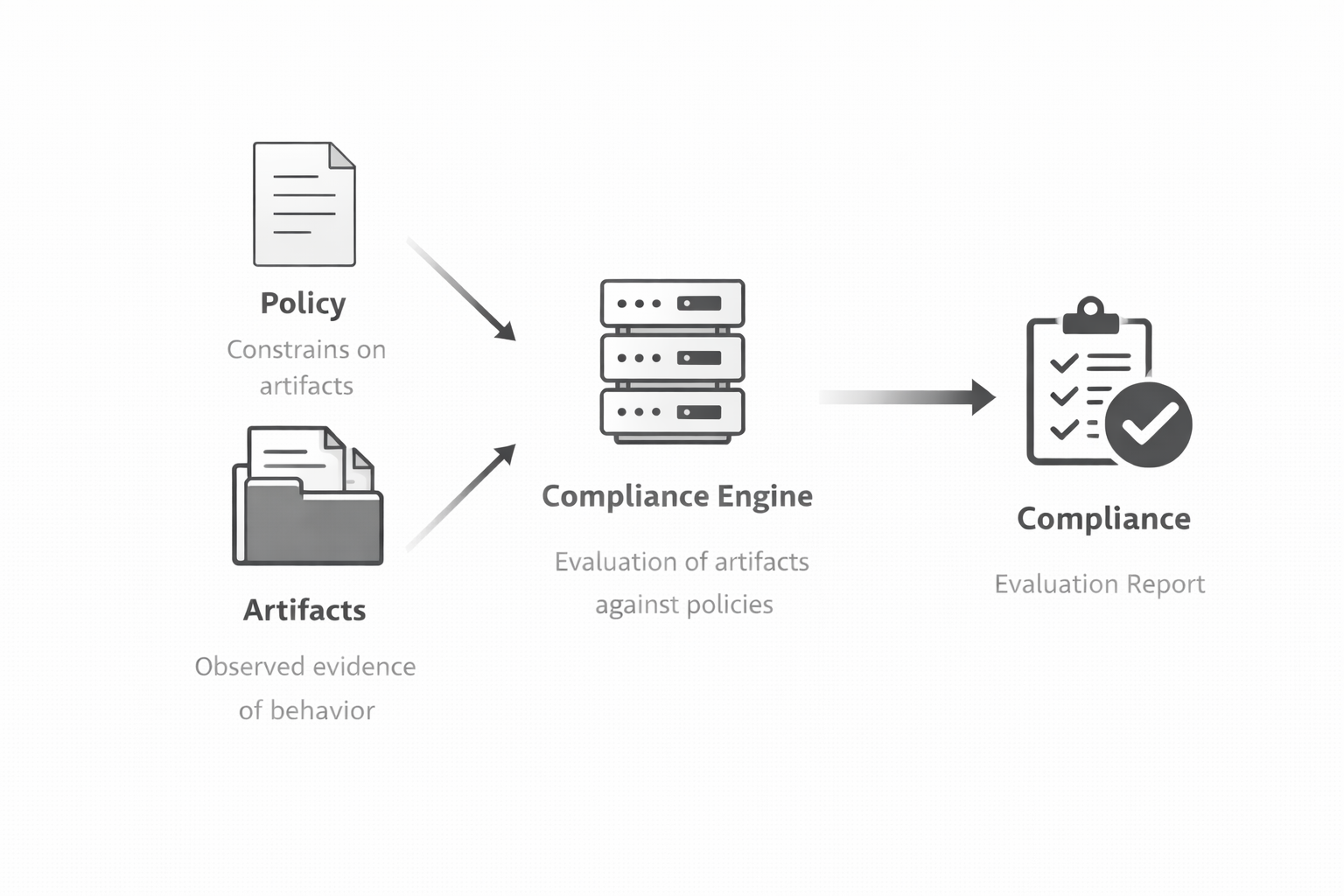
- Policy is the input. It defines constraints over what is considered acceptable.
- Artifacts are observations of behavior. In many systems, artifacts must first be derived from runtime behavior before they can be evaluated. They represent what the system actually does or declares, captured as structured evidence.
- The compliance engine acts as an interpreter. It evaluates policies against artifacts according to well-defined semantics.
- Compliance is the result of execution, together with traceable evidence. The outcome is not just a boolean decision, but an explanation of why that decision was reached.
This separation allows policy, observation, and evaluation to evolve independently, while remaining tightly coupled through explicit semantics.
Example: certificate compliance as a policy DSL
To make this concrete, consider X.509 certificate compliance.
Certificates are deterministic artifacts: their structure and fields are well-defined, and their validity can be evaluated purely from their contents. At the same time, certificate requirements are typically described in prose (RFCs, internal policies) and implemented directly in code.
I wanted to create a flexible way to express certificate compliance requirements as data, separate from the code that evaluates them and as a consequence, a domain-specific language emerged naturally without the intention to create one.
To illustrate, here is an example policy expressed in YAML that captures a subset of RFC 5280 requirements for X.509 certificates:
id: rfc5280
rules:
  - id: version-v3
    target: certificate.version
    operator: eq
    operands: [3]
    severity: error

  - id: signature-algorithm-secure
    target: certificate.signatureAlgorithm.algorithm
    operator: in
    operands:
      - SHA256-RSA
      - SHA384-RSA
      - ECDSA-SHA256
    severity: error

  - id: rsa-key-size-minimum
    when:
      target: certificate.subjectPublicKeyInfo.algorithm
      operator: eq
      operands: [RSA]
    target: certificate.subjectPublicKeyInfo.publicKey.keySize
    operator: gte
    operands: [2048]
    severity: error

  - id: ca-basic-constraints
    target: certificate.basicConstraints.cA
    operator: eq
    operands: [true]
    severity: error
    appliesTo: [root, intermediate]

  - id: key-usage-leaf
    reference: RFC5280 4.2.1.3
    target: certificate.keyUsage
    operator: keyUsageLeaf
    severity: error
In this model, policy defines explicit constraints over certificate artifacts – for example, that a certificate must use version 3 or that an RSA key must be at least 2048 bits long.
The certificate itself is treated purely as an artifact: an observed and immutable representation of system behavior. It is not coupled to any specific policy and carries no inherent notion of compliance.
A dedicated compliance engine interprets the policy against the artifact by:
- resolving certificate fields,
- applying domain-specific operators,
- evaluating conditional rules,
- and collecting the results of each evaluation.
The outcome of this process is a structured evaluation report. Rather than producing a simple pass or fail result, the report captures:
- which rules were evaluated,
- which values were observed,
- which constraints passed or failed,
- and which standards or references were involved.
Crucially, policy remains independent of how certificates are parsed, collected, or stored. The same engine can evaluate multiple policy sets, apply different compliance profiles, or re-run evaluations over previously captured artifacts for auditing and traceability purposes.
What began as a flexible approach to certificate validation naturally evolved into a domain-specific language – not by deliberate language design, but as a direct consequence of separating policy from implementation and making compliance explicit and executable.
If you want to know more about this project and lint some certificates yourself, check out the PCL GitHub repository.
Conclusion
Scalable software compliance starts with a simple shift in perspective.
When system behavior is represented as artifacts, and policies are expressed as explicit constraints over those artifacts, compliance becomes something that can be interpreted rather than hard-coded. Domain-specific languages provide the missing link: a way to make policy executable without embedding it directly into implementation logic.
The result is a model that scales naturally. Artifacts can be generated independently, policies can evolve over time, and evaluations can be repeated, audited, and explained. Instead of adding more checks, we add clarity.
Once compliance is treated as data plus interpretation, the complexity doesn’t disappear – but it becomes manageable.